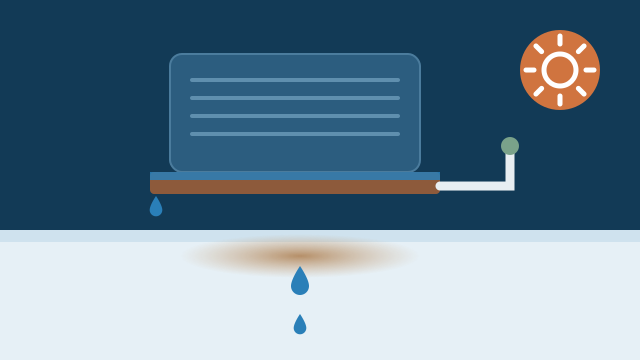
Clogged condensate line
Algae, dust and debris build up in the trap and the line until the water backs up and overflows the primary pan.
Clue: standing water in the pan; little or nothing dripping from the line's outside end on a hot day.
A stain near a supply vent, the return grille or the attic hatch, in the middle of summer when it hasn't rained for months, is almost always the air conditioner's condensate line or drain pan. Get connected with a local contractor who can get the line repaired and fix the ceiling it damaged.
In a lot of Diamond Bar homes, especially two-story tracts and single-story homes without a hallway closet for the furnace, the indoor unit sits in the attic directly over a finished ceiling. Summer afternoons here regularly reach the high 80s and 90s, and heat waves push past 100, so the system runs for hours and makes a steady stream of condensate.
A stain that appears or grows on hot afternoons when it hasn't rained, centered near the air handler's location, a vent, the return grille or the attic hatch. It often stops when the AC is off.
Most of the time nothing is wrong with the cooling itself. The problem is the small, unglamorous drain system: a pan, a trap, a ¾-inch line and, if you're lucky, a backup. When any part of it fails, the water has only one place to go.
Algae, dust and debris build up in the trap and the line until the water backs up and overflows the primary pan.
Clue: standing water in the pan; little or nothing dripping from the line's outside end on a hot day.
Metal secondary pans sit under the unit for years with a little water in them. Eventually they rust through and drip directly onto the drywall.
Clue: rust stains in the pan, and a stain right under the unit's footprint.
A slip joint pulls apart, a fitting cracks, or someone in the attic kicks the line loose. Water drains into the insulation instead of outside.
Clue: wet insulation along the line's route, not just under the unit.
A dirty filter or low refrigerant can freeze the coil. When it thaws, more water comes off at once than the pan and line can handle.
Clue: weak airflow, ice on the copper line, then a sudden leak after the system shuts off.
Where the line can't drain by gravity, a small pump lifts the water out. When the pump fails, the reservoir overflows.
Clue: a small plastic box near the unit that's full of water and silent.
Condensing furnaces also make water in heating season. If their drain shares the AC line and it's clogged, you can get a winter leak with no rain involved.
Clue: a stain under the unit in December, on a dry day.
About backup protection. Current California mechanical code calls for secondary protection where an overflow would damage the building: a second pan with its own drain, a separate overflow line, or a switch that shuts the system off when water rises. Many older attic installs predate that or have a pan whose drain was never connected. After an AC leak, it's worth asking your HVAC technician which protection you actually have.
What Diamond Bar homeowners ask when the AC is the cause.
An air conditioner pulls a lot of water out of the air as it cools. That condensate drips into a pan under the indoor coil and drains away through a small PVC line. When the line clogs with algae and dust, the pan overflows. When the pan itself rusts through or the line comes apart at a joint, water goes straight onto the ceiling drywall below.
Yes, until the leak is dealt with. Every hour it runs, it makes more water. Turn it off at the thermostat, put a bucket under the drip, and if water is near a light or the ceiling is bulging, switch off that breaker and keep people out from under it.
Often, yes. Many lines have a cleanout tee near the air handler or a capped opening outside where the line ends. A wet-dry vacuum on the outside end usually pulls the clog out. If the pan is rusted, the line is cracked or the clog keeps coming back, that's a job for your HVAC technician.
Float switches shut the system down when water rises in the pan, but they only protect against an overflow. They can't stop a leak if the pan has rusted through, the switch is set too high, or the water is escaping from a cracked fitting before it reaches the pan. Older Diamond Bar installs may have no backup protection at all.
It depends on the policy and on how long it went on. A sudden overflow from a clog is often treated differently from a pan that's been rusting and dripping for weeks. Document it before cleanup and see the guide to what California policies cover.
Call the installer first and put it in writing with photos. A disconnected drain line, a pan that isn't level or a missing trap on a new system is usually an installation problem, not wear. The ceiling contractor can document what's found inside the ceiling so you and the installer are working from the same facts. The guide new AC leaking into the ceiling: who pays? covers warranties and insurance.