Can a Ceiling Collapse From Water Damage? Signs & Timing
Yes. A wet drywall ceiling can come down, sometimes with almost no warning. Here's what makes it more likely, the signs to watch for, and what to do in the next ten minutes if yours is bulging.
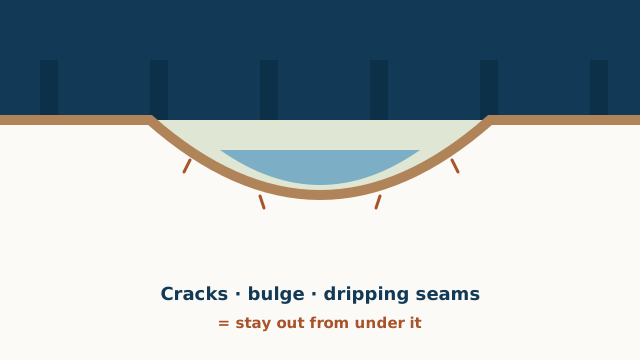
Yes, water-damaged ceilings can and do collapse. Wet gypsum loses much of its strength, and the water and soaked insulation above add weight the drywall was never designed to carry. A bulging, cracking or dripping ceiling should be treated as a collapse risk: keep people out from under it, turn off nearby power, and relieve or remove the water.
Why a wet ceiling comes down
A drywall ceiling is a thin sheet of gypsum held together by paper on both sides and screwed to the joists every foot or so. Dry, it easily carries its own weight and a layer of insulation. Wet, three things change at once.
- The gypsum gets weak. Saturated gypsum keeps only a fraction of its dry strength, and the paper facing, which does much of the work, softens.
- The fasteners lose their grip. Screw and nail heads pull through soft paper, so the sheet starts hanging from fewer and fewer points.
- The load goes up. A gallon of water weighs about 8.3 pounds. Water ponding on top of the drywall, plus insulation that's soaked it up, can add many times the weight the ceiling was carrying the day before.
That's why collapses often happen in a section, not the whole room. The wettest panel lets go, usually at a seam, and dumps whatever was sitting on it.
The warning signs, in order of urgency
| What you see | What it means | Urgency |
|---|---|---|
| Round bulge, possibly glossy, dripping | Water is pooled on top of the drywall | Now |
| Cracking or creaking sounds | The sheet or seams are failing | Now |
| Seams opening, tape peeling, fastener heads popping | The sheet is pulling away from the joists | Now |
| Sag that's deeper than yesterday | Ongoing water or weakening | Today |
| Soft spot when gently pressed with a broom handle | Drywall has lost strength | Today |
| Stain that's firm, flat and not growing | Old water, dried out | Not urgent |
What makes collapse more likely
Lots of water, fast
A burst supply line, a water heater failure in the attic or a toilet that ran for hours can soak a ceiling far faster than any roof leak. Those are the events where ceilings come down the same day.
Blown-in insulation above
Loose-fill cellulose and fiberglass soak up water and sit right on the drywall. Cellulose in particular gets heavy and stays wet. Older Diamond Bar homes often have had blown-in insulation added over the original batts, so there's a lot of material to soak.
Wide joist spacing and thin board
Ceilings framed at 24 inches with standard half-inch drywall have less margin than ceilings at 16 inches or with thicker board. Many trussed roofs use 24-inch spacing.
Repeated wetting
A ceiling that's been wet and dried many times, as with a recurring roof or bathroom leak, has been weakened each time, even if it looks fine between leaks.
Popcorn texture
Acoustic texture absorbs water and adds weight, and in older homes it may contain asbestos. A wet popcorn ceiling shouldn't be scraped or broken up; see popcorn ceiling repair.
What to do in the next ten minutes
- Get everyone out from under it, including pets. Close the door if you can.
- Turn off the power to lights, fans and outlets in that room at the breaker.
- Stop the water at the fixture or the main shut-off.
- Move what you can from the edges of the room without walking under the sag.
- Relieve the water, only if it's safe. A small hole at the lowest point over a bucket, standing to the side.
- Photograph it from the doorway.
If part of the ceiling has already fallen, stay out of the room, keep power off, and don't try to hold up or push back the rest. Get help to brace or remove the loose material safely.
The step-by-step for draining a bulge is on the emergency ceiling leak page. What happens next, from bracing to replacement, is on the sagging ceiling repair page.
After the danger passes
Once the water's out and the source is stopped, the sagged or soaked sections are cut back to solid drywall, wet insulation is removed, the cavity is dried until readings are back to normal, and new drywall goes up. Drywall that sagged won't regain its strength after drying, so pushing it back up isn't a real repair.
Ceiling collapse questions
Timing, warning signs and what to do.
How long does it take for a wet ceiling to collapse?
There's no reliable timeline. A ceiling holding a pocket of water from a burst line can come down within minutes or hours. One that's been getting a little wet every time it rains can sag slowly for months. What predicts collapse isn't time; it's how much water and weight it's holding and how wet the drywall is.
What are the signs a ceiling is about to collapse?
A bulge or belly that's getting deeper, new cracks spreading from the wet area, drywall seams or tape pulling apart, screw or nail heads popping, water dripping from several points at once, and creaking or cracking sounds. Any one of these means keep people out from under it.
Can a ceiling collapse from a small stain?
A small, dry, firm stain isn't a collapse risk. The drywall has dried and kept its strength. The risk comes from drywall that's wet right now, soft, sagging or holding water above it.
Does a ceiling come down all at once?
Usually not. Most water-related collapses are one section, often the wettest panel letting go at a seam or around a light fixture, and dropping the water and insulation sitting on it. That's still enough to injure someone and soak the room, and the panels next to it may be weakened too.
Is a sagging ceiling covered by insurance?
If the water came from a covered sudden event, the resulting ceiling damage usually is too. Sag from a slow, long-running leak can run into the gradual-damage exclusion. Read what California policies cover.
Once a sagging ceiling dries, can it be pushed back up?
Rarely. Gypsum that's been soaked and sagged doesn't get its strength back when it dries, and screws pulled through wet paper won't hold. The sagged section is cut out and replaced. Sag that isn't water-related, like loose fasteners, is a different repair.