Fixtures and appliances
Shower pans, toilet seals, a washer hose, a dishwasher or a fridge line inside your neighbor's unit.
Usually: the unit owner's responsibility under default rules.
When the water comes from the unit above or a shared pipe, the ceiling is only half the problem. Get connected with a local contractor who can find and document the source, coordinate with your neighbor and HOA, and repair your ceiling properly.
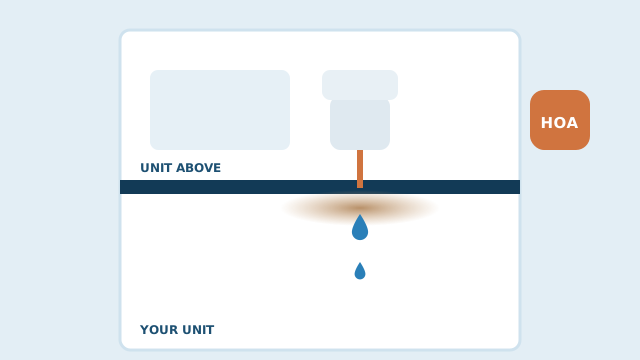
A ceiling leak in a single-family home is between you, your contractor and maybe your insurer. In a condo or townhome, add your upstairs neighbor, the HOA board, the management company, their insurer and possibly their vendors. Everyone wants to know the same thing: where did the water start?
The source in writing, with photos: which fixture, pipe or building component failed, whether it's inside the unit above or in a shared line, and how the water reached your ceiling. That's what decides who handles which repair.
Diamond Bar has a lot of attached housing: the condo and townhome communities along Diamond Bar Boulevard and Golden Springs Drive, Cimmaron Oaks, and gated communities with their own associations. Each has its own CC&Rs and its own way of handling leaks.
Shower pans, toilet seals, a washer hose, a dishwasher or a fridge line inside your neighbor's unit.
Usually: the unit owner's responsibility under default rules.
Vertical supply and drain lines serving more than one unit, often inside the walls between units.
Usually: common area, the association's to repair.
Roof leaks, balcony or deck membranes over a living space, and exterior wall or window leaks.
Depends: the roof is usually common area; decks are often exclusive-use areas.
These are typical patterns, not rules. Your CC&Rs and condominium plan decide, and they vary from one Diamond Bar community to the next.
What owners and boards ask when water crosses a unit line.
Knock on your neighbor's door or call them, and ask them to shut off whatever is running and the water to their unit if they can. Then call your HOA or management company's emergency line. Turn off the breaker for any wet light, catch the water, and photograph everything with the time showing.
It depends on where the water started and on your association's CC&Rs. Under California's default rule, the HOA handles common areas and owners handle their own units, but the governing documents can change that, and a neighbor who caused the leak may be responsible. The guide Condo leak from the unit above: who pays? walks through it.
Yes. Ceiling contractors who do condo work regularly coordinate access, schedule around association rules, and can send the manager the same photos and written findings you get. If the HOA has its own vendor for the source repair, the ceiling contractor can work alongside them.
Put the request in writing to your neighbor and the association, with photos and dates. Most CC&Rs give the association a right of entry for repairs it's responsible for, and associations have procedures for urgent access. Keep documenting while you wait, because ongoing damage matters for the claim.
Call your own agent. Your HO-6 policy may cover your interior and belongings regardless of who's at fault, and your insurer can pursue the responsible party afterward. Also ask the HOA for its master policy details and what it covers.
Often, but not always. In many townhome communities you own the structure and roof of your unit, while in others the association does. The CC&Rs and the condominium plan or map define it. That's why the documents matter more than the label.