In a house worth what most Diamond Bar homes are worth, a patch you can see from the couch isn't a finished repair. The texture is blended into the existing ceiling and the ceiling repainted so the repair matches.
The ceiling textures in Diamond Bar homes, and how each is matched
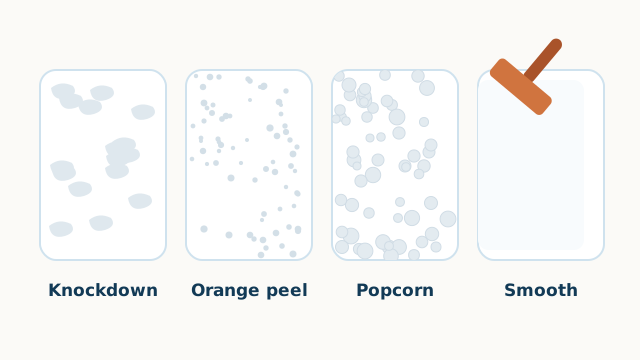
Each texture is applied differently, so matching starts with identifying it correctly. Hold a flashlight flat against the ceiling and the pattern is easy to see. For a fuller identification guide, see ceiling texture types.
Knockdown
Splatters of joint compound that are flattened with a wide knife before they set, leaving a mottled, stucco-like pattern. Very common in homes built through the '80s and '90s.
How it's matched: thinned all-purpose compound sprayed or splattered at the same density, then knocked down at the right moment. A few minutes too early or too late changes the look, so it's tested on a scrap board first.
Orange peel
A fine, even spray that looks like the skin of an orange. Subtle, but easy to get wrong: too heavy and it looks like a different ceiling.
How it's matched: sprayed with a hopper gun at adjusted pressure and compound thickness, with practice passes until the droplet size matches, then feathered past the edges of the repair.
Skip trowel
Compound dragged lightly across the surface with a trowel or wide knife so it "skips," leaving irregular raised patches. Hand-applied, so every ceiling is a little different.
How it's matched: by hand, studying the size and direction of the existing pattern, with very light pressure and blending out onto the old texture.
Popcorn (acoustic)
The cottage-cheese texture sprayed on many ceilings into the early 1980s. In Diamond Bar's older homes it's often original, and it may contain asbestos.
How it's handled: tested before it's disturbed, then spot-repaired with new acoustic texture or re-done, depending on the result. See popcorn ceiling repair.
Smooth
No texture at all, just a flat, painted ceiling. It looks clean, but shows every hump and seam when light hits it from a window.
How it's matched: skim coated and sanded flat, then checked with a light held flat to the surface before priming.
Not sure which you have?
Take a photo with your phone's flashlight on, held close to the ceiling at an angle, and text it. The shadows make the pattern obvious.
Four reasons ceiling patches stand out, and how to avoid them
The patch isn't flat. Texture doesn't hide a hump; it highlights it. The drywall repair underneath has to be finished flat first. See ceiling drywall repair.
The wrong compound. Fast-setting "hot mud" is great for filling and taping but too coarse for texture. Texture goes on with all-purpose compound for a creamier finish that matches older ceilings.
A hard edge. New texture that stops at a line shows from across the room. It's feathered out past the repair and onto the existing ceiling until it fades in.
Flashing in the paint. New compound absorbs paint differently from an old ceiling, so the patch shows as a dull or shiny spot. A stain-blocking primer on the repair, then the whole ceiling repainted, fixes it.
Stain on a ceiling that's still sound?
If the drywall is firm and dry, it doesn't need replacing. The stain is sealed with a stain-blocking primer so it can't bleed through, then the ceiling is repainted. Painting over a stain without sealing it is why so many come back.
Paint
Priming and painting so the color and sheen are even
Seal the stain
Water stains contain minerals and tannins that bleed through ordinary paint. A stain-blocking primer locks them in.
Prime the repair
New compound and texture are primed so they take paint the same way as the rest of the ceiling.
Paint wall to wall
A flat ceiling paint across the whole ceiling, cut in cleanly at the walls, so there's no outline of the repair.
Common questions
Texture matching questions
How a ceiling repair is blended in, and where the limits are.
Can my ceiling texture be matched exactly?
Knockdown, orange peel and skip trowel can usually be matched closely enough that nobody notices once the ceiling is repainted. Popcorn is harder: new acoustic texture rarely looks identical to a 40-year-old ceiling, so ask up front whether a spot repair will show, and about options such as re-texturing the whole ceiling.
Why does a patch still show after it's painted?
Usually because of sheen and absorption, not texture. New joint compound and primer soak up paint differently than an old painted ceiling, so a patch looks shinier or flatter in certain light. That's called flashing. Priming the repair and repainting the whole ceiling, wall to wall, is what makes it blend in.
Should the whole ceiling be repainted, or just the patch?
The whole ceiling, in most cases. Even with the same paint, a fresh patch next to a ceiling that's been up for years won't match in color or sheen. If the ceiling runs into a hallway or stairwell without a break, the contractor should explain where a natural stopping point is.
Can I switch to a smooth ceiling while you're repairing it?
Yes. A smooth finish is done by skim coating the whole ceiling and sanding it flat, sometimes called a Level 5 finish. It's more work than matching an existing texture, and smooth ceilings show every flaw in raking light, so it suits rooms with good, even lighting. If the existing texture is popcorn, it has to be tested before it's removed.
How long before a textured repair can be painted?
Texture needs to dry completely first, usually overnight and sometimes longer for heavy knockdown or in cool, damp weather. Painting too soon can soften or lift the texture.