Prep and seal
Room emptied, floors covered, walls and openings sealed with plastic, HVAC vents covered.
Taking a popcorn ceiling down is straightforward once you know what's in it. Test it first, then remove it the right way for the result, and finish the ceiling smooth or with a modern texture, which is especially worth it after a leak.
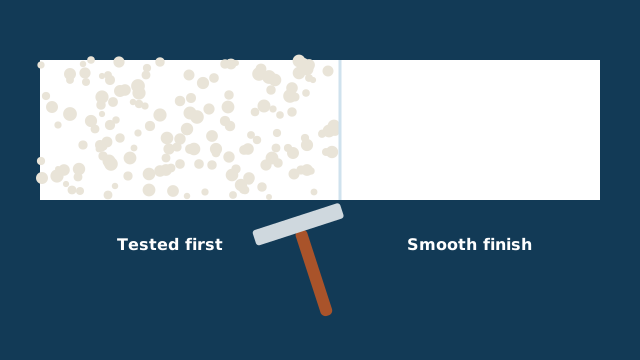
Acoustic "popcorn" texture was sprayed on Southern California ceilings for decades, and some of it contains asbestos, particularly in homes built before the early 1980s. Plenty of Diamond Bar homes from the '60s and '70s still have the original. You can't tell by looking.
A small sample goes to an accredited lab. If it's negative, the texture is wetted and scraped under plastic, and the ceiling is refinished. If it's positive, removal is done by an asbestos abatement contractor under South Coast AQMD Rule 1403, and the ceiling is refinished afterward.
A water-damaged section changes the urgency. Wet popcorn loosens and falls in clumps, which is exactly the kind of disturbance you don't want before you know what it is. If yours is wet now, read water-damaged popcorn ceiling repair first.
Room emptied, floors covered, walls and openings sealed with plastic, HVAC vents covered.
Texture lightly misted to soften it and keep dust down, then scraped with a wide blade.
Debris bagged inside the containment, plastic rolled up and removed.
Tape joints, nail pops, gouges and any water damage repaired; skim coats as needed.
Primed, then left smooth or textured, and painted.
| Finish | Looks | Hides flaws | Effort |
|---|---|---|---|
| Smooth (skim coated) | Clean and modern | Least: shows every joint in side light | Most |
| Orange peel | Subtle, fine texture | Some | Moderate |
| Knockdown | Mottled, common in local homes | Good | Moderate |
| Skip trowel | Hand-applied, varied | Good | Moderate to high |
Not sure which suits your home? The guide to ceiling texture types shows what each looks like and where it's common.
Under South Coast AQMD Rule 1403, townhouses and condominiums aren't treated as single-unit dwellings, so the homeowner exemptions that apply to houses don't apply. Many HOAs also have their own rules for contractors, work hours and asbestos handling. In an attached home, plan on testing, and expect the abatement path to be more formal if it tests positive. More on attached-home repairs is on the condo ceiling leak page.
Testing, the process and the finish afterward.
After testing, the room is emptied and sealed with plastic, floors and walls are covered, and the texture is misted with water and scraped off with a wide blade. The ceiling underneath is then repaired, skim-coated where needed, primed and finished smooth or with a new texture. If the test shows asbestos, removal follows the abatement path instead.
Often it's the best time. A leak usually means some popcorn has to come off anyway, the room is already disrupted, and matching old acoustic texture on a patch rarely looks right. Removing the whole ceiling's texture gives you one even finish instead of a patch.
Rarely perfect. Popcorn often hid rough tape joints, nail pops and uneven drywall. Most ceilings need some taping and skim coating before they look good smooth. Choosing a light texture like orange peel or knockdown instead of smooth hides more and costs less.
Yes, one room or area at a time, with that area sealed off. For asbestos-containing material, the abatement contractor's containment rules decide who can be in the house and when.
For a typical room with negative test results: about a day to prep and scrape, then several days of taping, skim coating, drying and finishing before primer and paint. If abatement is needed, add the notification period and the abatement work itself before the finish work starts.
Only after a lab confirms there's no asbestos, and even then it's messy work overhead. If it tests positive, Rule 1403 and safe-handling rules come into play; see the guide to popcorn ceiling asbestos rules.