Can You Paint Over a Ceiling Water Stain? Do It Right
Yes, if the leak is fixed and the ceiling is dry. The catch is that regular paint can't hide a water stain. Here's why, which primer actually works, and the steps that keep it from coming back.
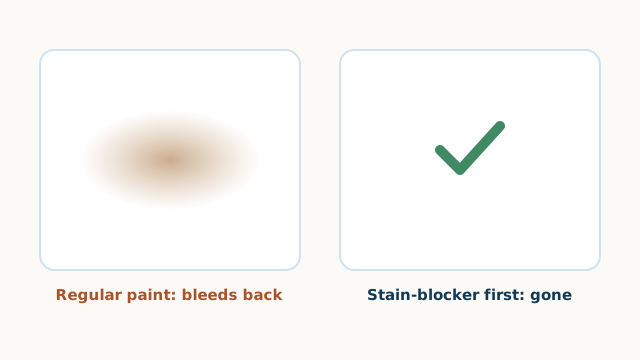
You can paint over a ceiling water stain after the leak is fixed and the drywall is fully dry. Clean the area, seal the stain with an oil-based or shellac-based stain-blocking primer extended past the outer ring, touch up texture if needed, then repaint the ceiling, ideally wall to wall, with flat ceiling paint.
Before you paint: two things to confirm
1. The leak is really over
Many ceiling leaks are intermittent. A shower pan only leaks when the shower runs; an AC line only leaks on hot days; a roof only leaks in storms. If you paint a stain from a leak that hasn't been fixed, it'll be back with the next shower, the next heat wave or the next rain. Not sure? The guide on whether a ceiling stain is dangerous covers how to tell old from active.
2. The drywall is dry and solid
Press next to the stain. If it's soft, crumbly, sagging or the paper is bubbling, paint isn't the fix; the section needs to be replaced. If it's firm, check that it's dry all the way through. A moisture meter is best. Without one, give it at least a week after the last sign of water.
Why stains bleed through regular paint
The ring isn't really "water." It's what the water left behind: minerals from the water supply, tannins from wood framing, dust and residue from insulation, all carried to the surface and left there as the water evaporated.
Latex ceiling paint is water-based. When you roll it on, it re-wets those deposits, dissolves some of them, and they migrate into the fresh paint as it dries. The result is a faint ring that reappears a day later, often just as visible as before. Two or three more coats of the same paint usually don't help.
Which primer actually blocks a water stain
| Primer type | Good for | Trade-offs |
|---|---|---|
| Shellac-based | Heavy, stubborn water stains; dries fast; also seals odors | Strong fumes, needs ventilation; cleans up with denatured alcohol |
| Oil-based (alkyd) | Most water stains; reliable and easy to find | Slower dry, odor; mineral spirits for cleanup |
| Water-based stain blocker | Light, faint stains; low odor | Heavy rings may still bleed through |
| Paint-and-primer in one | General repainting | Not designed to block water stains |
Many stain blockers come in spray cans, which work well for small spots and textured ceilings because they don't flatten the texture the way a roller can.
Step by step: painting over a ceiling water stain
- Protect the room. Drop cloths, furniture covered, light fixtures masked. Open windows if you're using a solvent-based primer.
- Clean the area. Wipe lightly with a damp sponge and mild detergent to remove dust and cobwebs. Let it dry.
- Deal with defects. Set any popped fasteners, scrape loose paint, and fill small cracks. Spot-prime any rusted nail or screw heads.
- Prime past the ring. Apply the stain blocker about 2 to 3 inches beyond the outermost visible edge. One coat is often enough; a heavy stain may need two.
- Check the texture. If the primer flattened the texture, touch it up with a matching texture spray so the area doesn't look smoother.
- Paint the ceiling. Flat ceiling paint, two coats, rolled corner to corner across the whole ceiling for an even sheen.
Older homes: if your home was built before 1978, older paint layers may contain lead. Priming over intact paint is low-risk, but avoid dry sanding or scraping large areas, and keep kids and pets out of the room while you work.
When it's not a paint job
- The drywall is soft, sagging or crumbling
- The stain has dark, fuzzy or speckled spots, or smells musty
- It's a popcorn ceiling in a home built before the early 1980s
- The stain came back once already after being primed properly
- The ceiling is high or vaulted and you'd be working off an extension ladder
In those cases, see ceiling water stain repair or ceiling drywall repair.
Painting over water stains: questions
Primers, drying time and when to repaint the whole ceiling.
Can you paint over a water stain on a ceiling?
Yes, once the leak has been fixed and the drywall is completely dry. Seal the stain first with a stain-blocking primer, preferably oil-based or shellac-based, then paint. Ordinary ceiling paint by itself almost always lets the stain bleed back through.
What is the best primer for a ceiling water stain?
Shellac-based and oil-based (alkyd) stain-blocking primers are the most reliable for water stains. Some water-based stain blockers work on light stains, but heavy brown rings often bleed through them. Whatever you choose, check that the label specifically lists water stains.
Why does the water stain come back through the paint?
Water-based paint re-wets the dried minerals and residue that make the stain, and pulls them up into the new coat as it dries. A solvent- or shellac-based primer doesn't re-dissolve them, so it locks them under a barrier the finish coat can't disturb.
Do I have to paint the whole ceiling?
For an even result, usually yes. Even the same ceiling white from the same can looks brighter than paint that's been up for years. Painting the full ceiling, wall to wall, avoids a bright patch. On a small stain in a closet or hallway, a feathered touch-up might be fine.
How long should I wait after a leak to paint?
Until the drywall is dry all the way through, not just on the surface. After a small leak that's been fixed, that's often several days to a week with good airflow; after a large one, longer. A moisture meter is the only real way to know. If you can't measure, wait at least a week and press to check it's firm.
Can I paint over a stain on a popcorn ceiling?
It's possible with a spray-on stain blocker, but acoustic texture soaks up paint and can come loose if it gets wet or is rolled. In homes built before the early 1980s it may contain asbestos and shouldn't be disturbed before testing. See popcorn ceiling repair.